Superfine: Tailoring Black Style – The Metropolitan Museum of Art
Champion
“Have pride in the way you dress, the way you talk, the way you walk, the way you carry yourself. Discipline is the thing that makes you a champion.”—Walt Frazier, “Walt ‘Clyde’ Frazier Is Still the NBA’s Greatest Style God—and He Knows It,” GQ, October 6, 2016
For Black men, athletic success has often been a route to both physical and fashionable distinction. Today, elegant and conspicuously colored, patterned, or accessorized clothing worn by athletes has become an indelible part of the entertainment value of sports. This form of Black dandyism distinguishes athletes as astute and visible tastemakers, often positioned at the nexus of sports and capitalism.
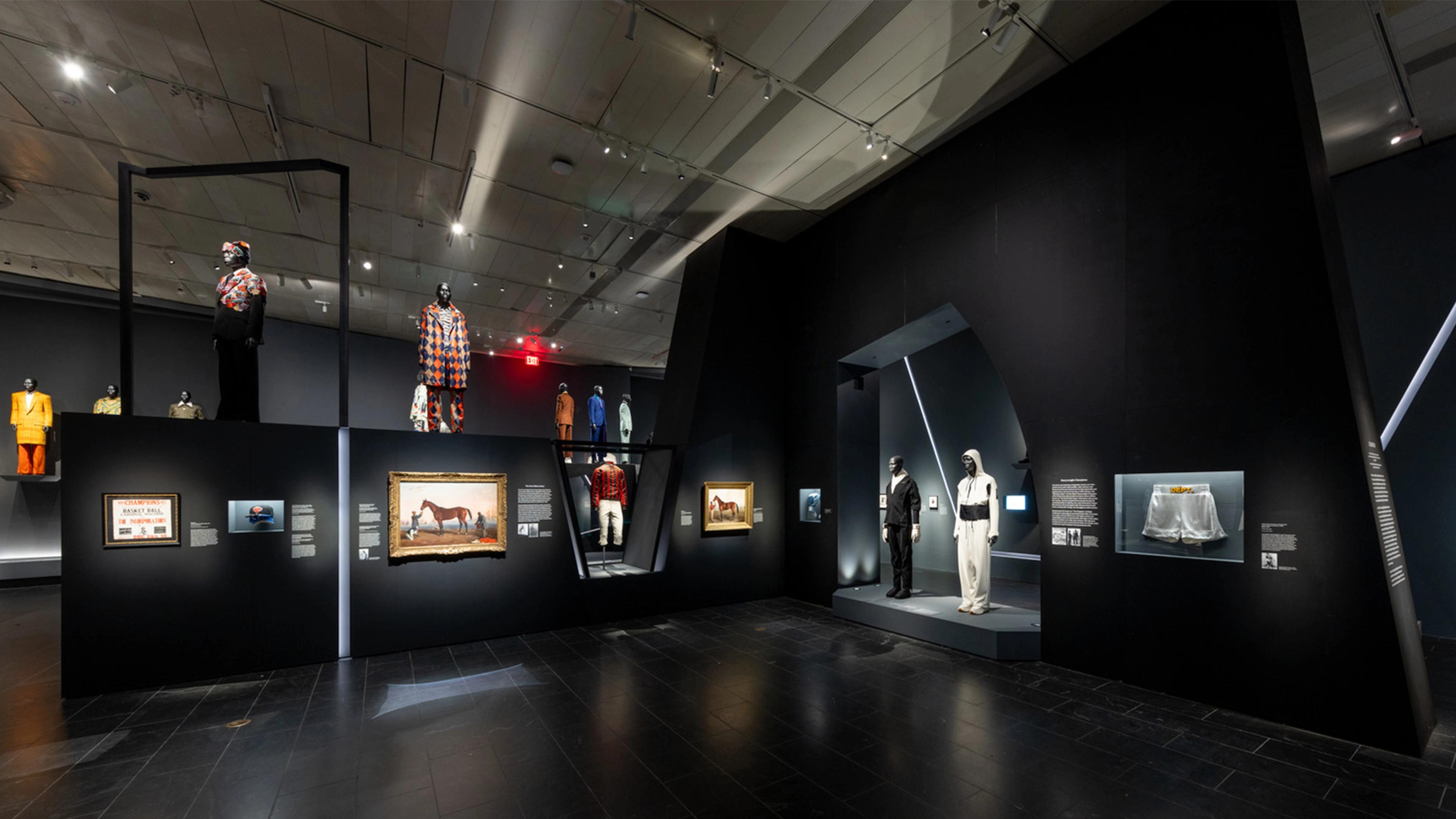
In the field of horse racing, Black jockeys found success until they were forced out of the sport in the early twentieth century. Enslaved Black jockeys often wore uniforms, or “silks,” that matched the livery of their enslavers, and both enslaved and emancipated jockeys frequently celebrated their success sartorially, dressing up in the highest fashions of the day. Boxers such as Jack Johnson and Muhammad Ali also lived extraordinary lives that challenged the boundaries of race, affording them avenues to fashionability not readily available to others. Likewise, from the time of legendary New York Knick Walt Frazier’s heyday in the early 1970s to now, basketball players have been sharp dressers and shrewd entrepreneurs, more recently using the NBA tunnel as a fashion runway.
As seen here, contemporary designers have elevated sports and athletic wear through historical references and experiments with form, resulting in garments that cover the body as well as some that reveal and revel in its musculature.
Heavyweight Champions
The fame and notoriety of legendary boxers are often reinforced by their fashionability. Jack Johnson and Muhammad Ali were both known for their physicality and appearance in and out of the ring. In 1910 Johnson, the “Galveston Giant” and first Black Heavyweight Champion of the World, famously knocked out boxer James Jeffries, known as “The Great White Hope,” which led to riots across the country. Johnson broadcast his success through his connoisseurship of clothing, cars, and controversy, living a life of luxury and extravagant style that provoked public ire for, among other things, his marriages to white women.
Muhammad Ali, known as “The Greatest,” similarly challenged racial regimes and social hierarchies. His career as a boxer and his efforts as a civil rights activist are unparalleled, and he conducted both with style. In their satiny texture and black-and-white color scheme, Ali’s signature Everlast shorts were a nod to the formalism of a tuxedo, while outside the ring he enjoyed wearing bespoke suits.
link