


Introduction
A key factor driving the global men’s intimate care products market is the changing societal attitude toward male grooming and personal hygiene. Today’s men, particularly those in urban settings, are becoming more concious of the importance of maintaining cleanliness and comfort in intimate areas. This change reflects a broader shift in the concept of masculinity, where self-care is increasingly seen as a sign of confidence and well-being rather than a taboo subject.
The rising focus on hygiene and health has led to greater demand for specialized products that address common concerns such as sweat, odor, and skin irritation. Moreover, digital media and male grooming influencers have played a crucial role in normalizing intimate care discussions, boosting consumer awareness and acceptance. With wellness routines becoming a regular part of men’s lifestyles, this trend is expected to fuel ongoing growth and innovation in the men’s intimate care segment.
Market Dynamics
Rising disposable incomes drive the global market
The global surge in disposable income is a major driver for the market’s expansion. As men, particularly in urban and semi-urban regions, gain greater financial independence, their inclination to invest in personal grooming and hygiene products grows notably. The expanding middle class in developing nations, along with increased purchasing power among millennials and Gen Z, is fueling demand for specialized personal care products.
- For example, household disposable income per capita across OECD countries rose by 1.8% in 2024, slightly up from 1.7% in 2023. In Q4 2024 alone, real household income increased by 0.5%, compared to 0.2% in the prior quarter. Among G7 nations, the U.S. and Canada witnessed significant gains in disposable income, with increases of 29.5% and 23.7%, respectively, from 2007 to mid-2024.
This improved financial capacity is opening new avenues for brands to diversify their offerings and enter premium segments of the market.
Educational campaigns create tremendous opportunities
Educational initiatives offer a substantial growth opportunity in the global market, particularly in regions where male hygiene remains a taboo subject. Such campaigns can play a crucial role in breaking social stigmas and encouraging open discussions around intimate care. By framing personal hygiene as an essential part of overall health, companies can strengthen their positioning as champions of men’s well-being.
- For example, Redcliffe Labs launched its #MendYourHealth campaign on International Men’s Day (December 12, 2024) to challenge traditional notions of masculinity in India. The campaign promotes conversations around mental health, preventive health checks, and emotional wellness, motivating men to prioritize their physical and mental well-being.
These kinds of awareness efforts can boost product usage, enhance brand credibility, and foster long-term consumer loyalty in the male hygiene market.
Regional Analysis
In North America, the men’s intimate care products market is experiencing robust expansion, driven by shifting cultural attitudes and increasing health awareness. Consumers in the U.S. and Canada are showing greater willingness to invest in personal hygiene, with a particular rise in demand for intimate washes, anti-chafing creams, and grooming wipes. Major retail chains like CVS and Walgreens have expanded shelf space for male hygiene products, while brands such as BALLS Co. and Manscaped are using influencer marketing and subscription models to attract younger consumers.
According to a 2024 Mintel report, over 60% of U.S. men aged 18–34 have tried or are open to using intimate grooming products. Additionally, rising awareness of conditions like jock itch and skin irritation has made functional intimate care a priority, creating opportunities for dermatologically tested, fragrance-free formulations tailored to North American preferences.
Key Highlights
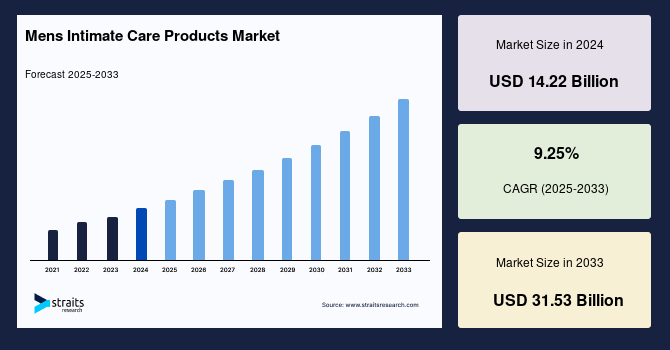
- The global men’s intimate care products market size was valued at USD 14.22 billion in 2024 and is estimated to grow from USD 15.54 billion in 2025 to reach USD 31.53 billion by 2033, growing at a CAGR of 9.25% during the forecast period (2025–2033).
- By product type, the global men’s intimate care products market is segmented into grooming products, body wash and soaps, deodorants and antiperspirants, creams and serums, and others.
- By ingredient type, the market is categorized into natural/organic and conventional/synthetic.
- Based on end user, the market is divided into teenagers, adults (20–40 years), and middle-aged and older adults (40+ years).
- By distribution channel, the market is segmented into online retail and offline retail.
- North America is the highest shareholder in the global market.
Competitive Players
- Unilever
- Procter & Gamble
- Beiersdorf AG
- L’Oréal S.A.
- Reckitt Benckiser Group plc
- Colgate-Palmolive Company
- The Himalaya Drug Company
- Man Matters
- Ballsy
- Chassis for Men
Recent Developments
- In July 2025, Harry Styles’ lifestyle brand, Pleasing, expanded into the intimate wellness space with its new line “Pleasing Yourself”. Launching with two products, a doublesided vibrator priced at $68 and a silicone-based lubricant at $25, the collection promotes inclusive and pleasure-positive self-care. The teaser slogan “Please yourself like you mean it” reflects the brand’s bold and expressive positioning.
Segmentation
- By Product Type
- Grooming Products
- Body Wash and Soaps
- Deodorants and Antiperspirants
- Creams & Serums
- Others
- By Ingredient Type
- Natural/Organic
- Conventional/Synthetic
- By End User
- Teenagers
- Adults (20–40 years)
- Middle-aged and Older Adults (40+ years)
- By Distribution Channel
- Online Retail
- Offline Retail
- By Regions
- North America
- Europe
- Asia-Pacific
- Latin America
- The Middle East and Africa
link